Large Dog Air Travel Calculator
Cost estimates based on 2026 airline policies
Want to fly with your Great Dane, Saint Bernard, or Mastiff? You’re not alone. More pet owners are taking their big dogs on trips - whether it’s a move across the country, a vacation to the coast, or visiting family during the holidays. But finding an airline that actually lets large dogs fly, especially in the cabin, isn’t easy. Most airlines have strict size and weight limits. And if your dog is over 20 pounds, you’re already in cargo territory. That’s where things get complicated.
Can Large Dogs Fly in the Cabin?
Almost never. Airlines like Delta, United, American, and Alaska allow small dogs in the cabin - but only if they fit in an approved carrier under the seat in front of you. That carrier usually has to be no bigger than 18 x 11 x 11 inches. Even the largest cabin-approved carriers won’t fit a 70-pound Labrador. So if your dog weighs more than 20 pounds, you’re looking at cargo travel. And that’s okay - as long as you know what to expect.
Some airlines have started offering larger pet carriers for cargo, but they still limit the total weight per pet. Most set a max of 100 pounds (including the carrier). That means if your dog is 95 pounds, you’ve got 5 pounds to spare for the crate. Many owners don’t realize how heavy those crates get - especially reinforced ones built for safety. A sturdy plastic crate for a 90-pound dog can weigh 15-20 pounds on its own.
Which Airlines Let Large Dogs Fly in Cargo?
Not all airlines accept large dogs in cargo. Some stopped the practice entirely after a few high-profile incidents. Others have tightened rules, added temperature restrictions, or banned certain breeds. Here’s who still allows large dogs in cargo as of early 2026:
- Delta Air Lines - Accepts dogs up to 100 lbs in cargo. Requires a health certificate issued within 10 days of travel. No brachycephalic breeds (like Bulldogs or Pugs) allowed year-round. Temperature-controlled cargo holds.
- United Airlines - Allows dogs up to 100 lbs. Has a PetSafe program with tracking and climate-controlled transport. Requires 48-hour advance notice. No service animals count toward pet limits.
- American Airlines - Permits dogs up to 100 lbs in cargo. Requires a USDA health certificate. Does not accept pets during extreme heat (May-September for many U.S. routes).
- Alaska Airlines - One of the most pet-friendly. Allows dogs up to 100 lbs. Offers real-time tracking via their Pet Tracker app. No breed restrictions beyond standard safety rules. Low incident rate compared to others.
- JetBlue - Only allows pets in cabin. No cargo option. So if your dog is over 20 lbs, JetBlue is out.
- Southwest Airlines - Also cabin-only. No cargo for pets. Not an option for large dogs.
International carriers like Air Canada, Lufthansa, and KLM also allow large dogs in cargo, but rules vary by country. For example, the EU requires microchips, rabies vaccines, and a 21-day waiting period after vaccination. Always check the destination country’s rules - they’re often stricter than the airline’s.
What About Breed Restrictions?
Even if your dog is under 100 lbs, some airlines won’t fly certain breeds. Brachycephalic dogs - those with short snouts - are at higher risk of breathing problems during flight. Airlines like Delta and American ban these breeds entirely. That includes:
- Bulldogs (English and French)
- Pugs
- Boxers
- Shih Tzus
- Chow Chows
- Some Mastiff breeds
Even if your Mastiff isn’t brachycephalic, some airlines still flag them due to size. Always call the airline’s pet department directly. Policies change often, and agents on the website might not know the latest updates.
How Much Does It Cost to Fly a Large Dog?
Flying a large dog isn’t cheap. Cargo fees vary by route, weight, and airline. Here’s what you’re likely to pay in 2026:
- Domestic U.S. flights: $250-$500 per pet
- International flights: $500-$1,200+ (depends on destination and customs fees)
- Extra fees: $50-$100 for oversized crates, $75 for last-minute bookings, $100+ for temperature-controlled holds
Some airlines charge per pound over 70 lbs. United adds $100 if your dog is over 70 lbs. Alaska charges $150 flat for dogs over 50 lbs - no extra per pound. Always ask about weight-based pricing before booking.
Don’t forget the cost of the crate. A USDA-approved plastic crate for a 90-pound dog costs $120-$200. Metal crates are heavier and often not allowed. Soft-sided carriers? Not permitted for cargo. You need a hard-sided, ventilated crate with a leak-proof bottom.
What You Need to Prepare
Booking the flight is just the first step. Here’s your checklist for flying a large dog:
- Health certificate - Issued by a licensed vet within 10 days of travel. Must include rabies vaccination proof and confirmation the dog is fit to fly.
- Microchip - Required for international travel and recommended domestically. Must be ISO-compliant (15-digit number).
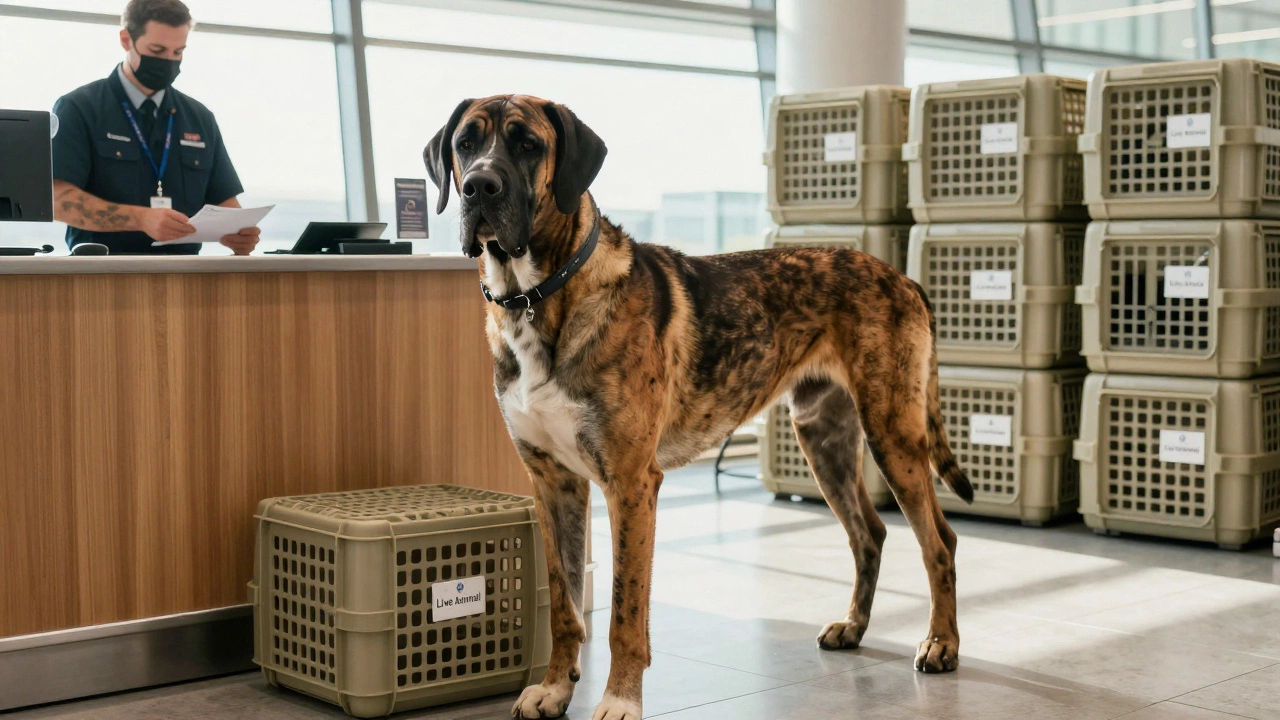
- Proper crate - Must be IATA-compliant. Your dog must be able to stand, turn, and lie down comfortably. Label it with your name, phone, and "Live Animal" stickers.
- Food and water - Attach a water bottle to the crate. No food inside the crate - dogs can choke or vomit during flight. Feed your dog 4-6 hours before check-in.
- Flight timing - Avoid extreme heat or cold. Don’t fly in summer if your route goes through Phoenix, Dallas, or Atlanta in July. Airlines suspend pet transport when temps hit 85°F or higher.
- Arrive early - Check in 2-3 hours before departure. Pet cargo drop-off is separate from regular check-in.
What to Avoid
Many owners make these mistakes:
- Trying to sneak a large dog into the cabin - you’ll be denied boarding, and your ticket may be canceled.
- Using a soft-sided carrier - it’s not safe for cargo and will be rejected.
- Waiting until the last minute - airlines limit the number of pets per flight. You might be turned away even if you’ve paid.
- Not acclimating your dog to the crate - if your dog panics in the crate, the stress can cause injury or worse. Start training 4-6 weeks ahead.
- Assuming the airline will care for your dog - cargo handlers move pets quickly. No one will walk, feed, or play with your dog during layovers.
Alternatives to Flying
If flying feels too risky or expensive, consider:
- Ground transport - Companies like PetRelocation or Dogtainers specialize in long-distance pet transport. They use climate-controlled vans and offer door-to-door service. Costs $800-$2,500 depending on distance.
- Driving - If you’re moving under 1,500 miles, driving is often cheaper and less stressful. Bring a crate, water, and rest stops every 2-3 hours.
- Professional pet couriers - These are private drivers who transport pets across the country. They’ll update you with photos and GPS tracking. Rates start at $1,000.
Many owners who’ve flown large dogs say the hardest part isn’t the cost - it’s the waiting. You can’t see your dog. You don’t know if they’re scared. That’s why some choose ground transport even if it takes longer.
Final Tips
Here’s what works for people who’ve done it:
- Book a direct flight. Layovers mean more handling, more heat exposure, more risk.
- Call the airline’s pet department - not customer service. They know the real rules.
- Take a photo of your dog in the crate before you drop them off. If anything goes wrong, you have proof.
- Consider pet travel insurance. It won’t cover death or injury, but it can cover delays, lost paperwork, or vet visits upon arrival.
- Feed your dog a light meal the night before. Skip breakfast the day of. Hydrate well, but don’t overdo it.
Flying with a large dog isn’t impossible. It’s just not simple. The right airline, the right prep, and the right expectations make all the difference. Alaska Airlines and Delta are the most reliable for big dogs right now. But no matter who you choose, plan early, ask questions, and never assume anything.
Can I fly with my 80-pound dog in the cabin?
No. Airlines only allow dogs under 20 pounds in the cabin, and even then, they must fit in a carrier under the seat. An 80-pound dog will need to travel in cargo. There are no exceptions for emotional support animals - the FAA no longer recognizes them as service animals on flights.
What if my dog is over 100 pounds?
Most airlines won’t accept dogs over 100 pounds, including the crate. Some may allow it with special approval, but it’s rare and expensive. You’ll likely need to use a ground transport service instead. Companies like PetRelocation or private pet couriers can handle larger animals safely.
Are there airlines that don’t allow large dogs at all?
Yes. JetBlue and Southwest only allow pets in the cabin, so they’re not options for dogs over 20 pounds. Some international carriers, like British Airways and Emirates, have stopped accepting large dogs in cargo due to safety concerns. Always confirm directly with the airline before booking.
How do I know if my dog’s crate is approved?
Look for the IATA (International Air Transport Association) label on the crate. It must be hard-sided, ventilated on all four sides, have a leak-proof bottom, and have a secure door latch. The crate should be large enough for your dog to stand, turn, and lie down without touching the top. Most pet supply stores sell IATA-approved crates - ask for one labeled "airline-approved" or "IATA-compliant".
Can I fly with two large dogs together?
No. Airlines require each dog to travel in a separate crate, even if they’re used to being together. They can’t be placed in the same crate for safety reasons. You’ll pay the full cargo fee for each dog. Some airlines limit the number of pets per flight, so book early if you’re traveling with more than one.